




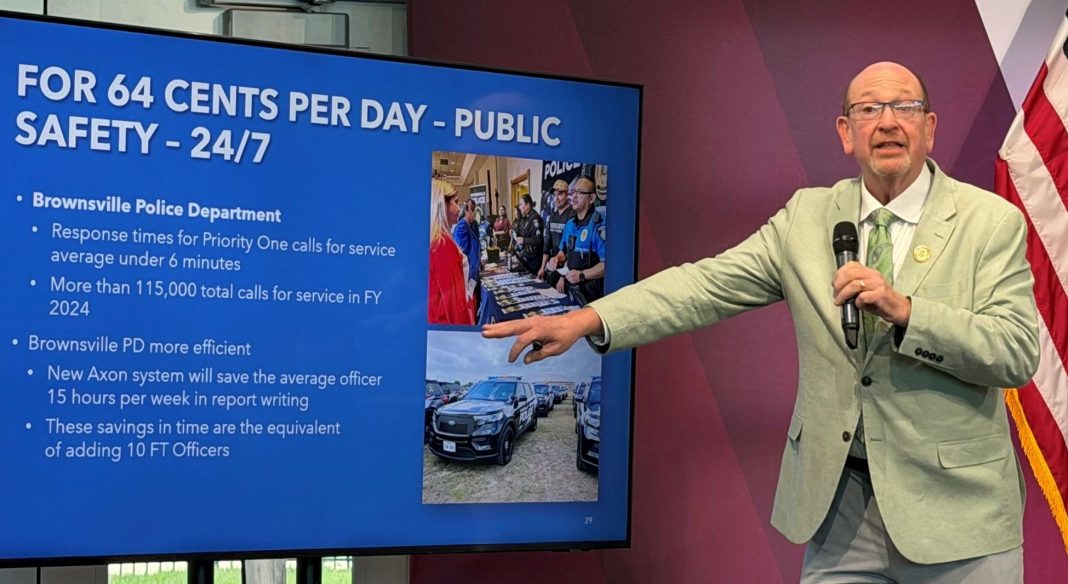
Community members and local stakeholders gathered for the first Friday with the City event of 2026, a partnership between the City of Brownsville and the Brownsville Chamber of Commerce, to hear Interim City Manager Alan Guard present an overview of the City of Brownsville’s Fiscal Year 2026 Budget and Capital Improvement Plan.
Guard addressed a large audience at the Communications and Marketing Department/Convention and Visitors Bureau Complex at 1312 East Adams St., on Friday, January 16, where he outlined the city’s upcoming priorities, planned investments, and major projects designed to support continued growth, infrastructure improvements, and long-term development.
During his presentation, Guard emphasized that the City of Brownsville operates much like a business, guided by a strategic plan built around six core pillars: economic development, planning and zoning, infrastructure, public safety, quality of life, vibrancy, and governance. He noted that the city manages a $138 million operating budget that supports 24 distinct departments and services.
“We are a business; we are a major corporation,” Guard said. “Our operating budget is $138 million and covers 24 businesses. We don’t just do one thing—we do 24 things, so we operate like a business.” He added that the city undergoes annual audits and completes a formal budgeting process each year to ensure accountability and transparency.
Guard also highlighted the City of Brownsville’s unique position in operating its own landfill, which generates approximately $9.6 million in revenue annually. He explained that this revenue supports the city’s general fund and helps offset the cost of essential services for residents.
“We take everybody’s garbage. We take it from Harlingen, we take it from Los Fresnos. The $9 million we take from the landfill fund and put into the general fund comes from people who don’t live here,” Guard said. “We have other people, other cities who are paying for your police and fire, your libraries, your parks, and I think that is brilliant.”
Reviewing general fund expenditures, Guard explained how city revenues are allocated, noting that more than half of the general fund, like in many municipalities, is dedicated to public safety services. He also shared that the City of Brownsville collects approximately $693 per capita in taxes each year, which equates to about $56.90 per month.
Guard emphasized that for just 64 cents a day in property taxes, Brownsville delivers essential services that protect public safety and enhance residents’ quality of life. Brownsville Fire and Rescue and Emergency Medical Services respond to emergencies in an average of under seven minutes and handle more than 37,000 combined fire, accident, and medical calls annually. Both departments also provide assistance to surrounding communities through a countywide mutual aid agreement.
The Brownsville Police Department averages response times of under six minutes for Priority One calls and handled more than 115,000 calls for service in fiscal year 2024. Guard highlighted recent technology investments, including the implementation of a new Axon system, which is improving efficiency by saving officers an estimated 15 hours per week in report-writing time—an impact equivalent to adding 10 full-time officers.
Community services were also highlighted during the presentation, including the Brownsville Public Library system, which consists of two locations open seven days a week and offers more than 330,000 physical and digital items, serving over 600,000 visitors annually. Guard also noted the role of the City’s 546-HELP Call Center, which handled nearly 89,000 calls in fiscal year 2024 and resolved more than 98 percent of service requests. So far in fiscal year 2025, the call center has resolved 99 percent of generated work orders.
Quality-of-life amenities remain a key focus for the city. Brownsville Parks and Recreation maintains 46 parks spanning more than 1,000 acres, along with trails, athletic fields, pools, a golf course, and community facilities. Transportation services include Brownsville Metro, which serves more than 1.1 million riders each year, and the Brownsville/South Padre Island International Airport, a modern regional gateway supporting both business and leisure travel.
Guard also discussed the City’s continued investments in health and wellness, including restaurant inspections, code enforcement, maternal and child health programs, fitness and wellness initiatives, and animal services. Brownsville Animal Services has made significant progress, increasing its animal save rate from 26 percent to more than 70 percent.
The Friday with the City event provided attendees with a comprehensive look at how the City of Brownsville’s budget and capital planning efforts translate into real-world services and community improvements, reinforcing how a small daily investment supports safety, access, and opportunity for residents.

