



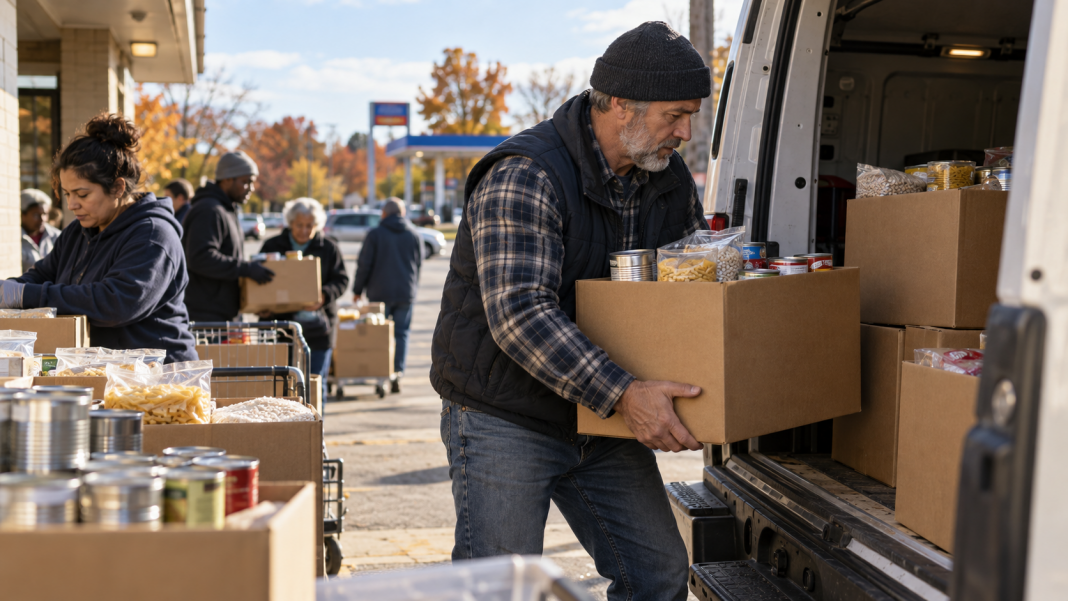
DETROIT – Higher fuel prices are adding pressure at both ends of the nation’s charitable food system, raising the cost of delivering groceries while making it harder for households to travel to food distributions or stretch already limited budgets.
In Detroit, the strain is visible in the growing delivery list at Focus: HOPE, a nonprofit that provides food and other services. The organization is now delivering about 1,300 monthly food boxes, up from roughly 800 at the beginning of the year, according to Reuters. Many recipients are older adults living on fixed incomes who cannot easily travel to a distribution site.
One recipient, 65-year-old Tonya King, lives with cerebral palsy and has limited mobility. A box delivered to her home can provide about two weeks of food for her six-person household. King told Reuters that the family’s financial problems have forced difficult choices, including deciding which medications can be purchased while also trying to address a broken furnace, a prolonged water outage and repairs to the home.
Frank Kubik, a director at Focus: HOPE, said rising gasoline and diesel prices have made the nonprofit’s work more expensive at the same time that the need for assistance is increasing. For people who pick up their food, the cost of driving to a distribution site can itself become a barrier.
The impact extends beyond Michigan. The Central California Food Bank said its diesel spending increased 61% from July through September compared with the same period a year earlier. The added cost was equivalent to the expense of about 250,000 meals, according to Reuters. The food bank supplies partner organizations that collectively serve more than 300,000 people each month.
In Illinois, the Greater Chicago Food Depository has been adjusting what it buys, including shifting toward less expensive food, to help offset fuel costs. Such changes can preserve the number of meals distributed, but they leave food banks with less flexibility as they try to provide a balanced selection of groceries.
Fuel prices affect food assistance in several ways. Trucks use diesel to move products from farms, processors and warehouses. Local food banks pay to collect donations and deliver orders. Families also face higher transportation costs while grocery prices can absorb some of the increased cost of production and distribution.
The current pressure is arriving as federal nutrition support is contracting. More than 4.7 million people have lost Supplemental Nutrition Assistance Program benefits since provisions of a federal tax and spending law took effect, Reuters reported. The combination of reduced assistance and higher household costs can push more families toward charitable providers that have limited budgets of their own.
Fuel prices have also become part of the debate ahead of the midterm elections. Nearly half of registered voters identified the cost of living as the most important factor in deciding how to vote, according to a Reuters/Ipsos poll cited in the report. Michigan’s U.S. Senate contest is among the races in which candidates are confronting public anxiety about household expenses.
King said she supports Democratic candidate Abdul El-Sayed. He is running against Republican Mike Rogers. Her comments illustrate how national economic debates are experienced at the household level, but food insecurity crosses party lines and affects communities in urban, suburban and rural areas.
Michigan Public reported separately that statewide fuel prices rose sharply in September. Regular gasoline reached an average of $4.93 a gallon on Sept. 21, about $1.75 higher than a year earlier, while diesel reached $6.89 a gallon on Sept. 23 before easing slightly. Food assistance groups in the Lansing area reported that the increases were affecting their delivery operations and the families they serve.
For food banks, the immediate challenge is keeping trucks on the road while meeting demand. Cash donations generally offer organizations the most flexibility because they can be used for fuel, warehouse operations and bulk purchases, though residents should verify a charity’s needs before donating. People seeking food assistance can contact 211 or a local food bank for information about eligibility, pickup locations and delivery programs.
Source: Reuters, published Oct. 22, 2026. Additional reporting and verification: Michigan Public.

