



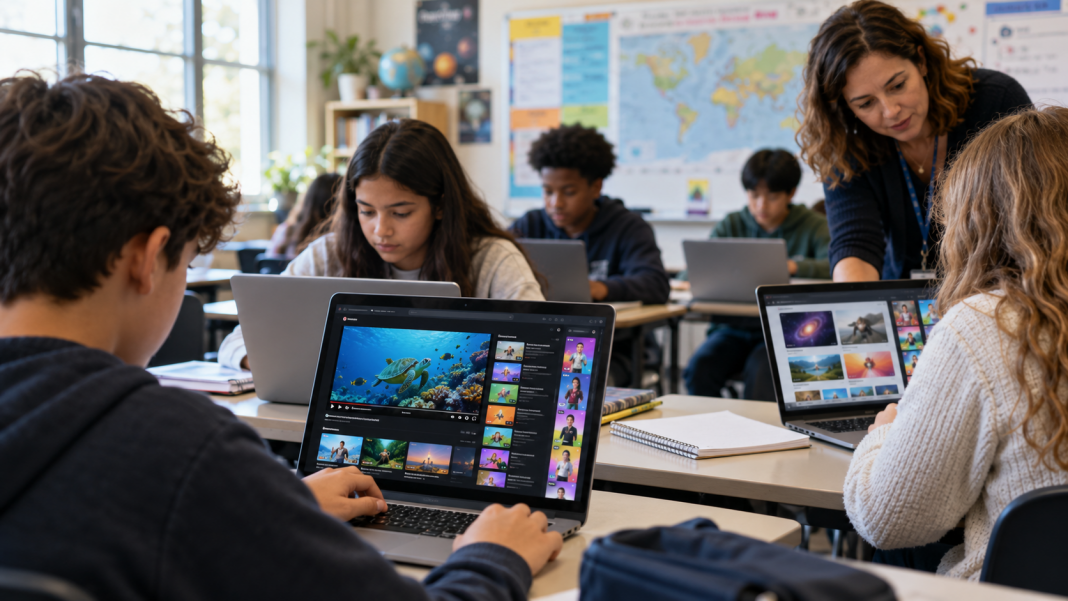
A review of YouTube activity from 11 students found that more than 95% of the videos and advertisements they watched were not educational, highlighting the difficulty schools face when they provide access to a website that is both a classroom resource and a major entertainment platform.
The NBC News analysis examined 17,355 viewing events collected from the YouTube histories of students in grades two through 12. The participating families lived in different parts of the country and had previously raised concerns about children’s technology use.
The findings provide a detailed look at the viewing habits of those students, but they should not be treated as a national estimate. The sample was small and self-selected, and the parents had already expressed concern about technology. It was not a random or representative survey of American students.
Within that sample, reporters found a steady stream of entertainment, short-form videos, gaming material and other distractions alongside classroom-related content. Some viewing histories also included videos with profanity, sexually suggestive material or references to drugs and alcohol, according to NBC News.
YouTube became deeply embedded in schools as teachers used videos to demonstrate experiments, explain difficult concepts, offer language instruction and supplement lessons. That use grew during pandemic-era remote learning, when districts rapidly expanded one-to-one laptop and tablet programs.
The same platform features that keep viewers engaged outside school can complicate classroom use. Recommendations, autoplay and short-form videos can lead a student away from an assigned lesson. Even when a child begins with an educational link, the page may present a menu of unrelated material selected by an automated recommendation system.
School officials can restrict YouTube in several ways, but each option involves tradeoffs. Administrators can block the website entirely, limit access for selected groups or use Restricted Mode, which is intended to filter mature content and can hide comments. A full block can also remove videos that teachers consider useful.
Google offers a separate Player for Education that allows approved educational videos to be embedded in learning products without advertisements, recommendations, comments or links back to the regular YouTube website. That system can reduce distractions within participating educational services, but it does not solve the problem when students can browse the main site through a school device.
YouTube says autoplay is turned off by default for users ages 13 to 17. Parents using supervised accounts can also adjust content settings and other controls. Those safeguards depend on account configuration, and schools still must decide how much open access is appropriate for different ages and assignments.
The broader debate is not limited to one platform. Federal education data showed that 96% of public schools provided digital devices to students who needed them during the 2021-22 school year. As laptops became routine, districts began weighing their educational value against distraction, screen time, student privacy and the cost of monitoring software.
Some school systems are moving toward tighter limits. The Los Angeles Unified School District adopted policies that restrict access to YouTube and reduce screen use, and lawmakers in at least 14 states introduced proposals this year addressing screen time in schools, according to Associated Press reporting.
For families, a useful first step is to review the settings and viewing history on a child’s account rather than assuming school-issued equipment is limited to schoolwork. Parents can ask a district whether YouTube is open or restricted, which filtering tools are used, how alerts are reviewed and whether teachers can provide videos through a distraction-free player.
Educators can also provide direct links, use approved learning platforms, set clear expectations for an assignment and avoid leaving students to search an open video site when a specific resource is intended. No single filter will prevent every distraction, especially when students have access to personal devices outside school.
The NBC analysis does not establish how most students use YouTube, but it documents a practical problem for schools: a platform designed to maximize viewing can work against classroom goals unless access, supervision and lesson design are managed together.
Source: NBC News, published Oct. 22, 2026. Additional reporting and verification: YouTube Help, Google for Education and The Associated Press.

