




By Saira Cabrera
RIO GRANDE VALLEY, TEXAS – NOV. 6, 2025 – In a landmark victory for medical research and brain health, Texas voters have approved Proposition 14 on Nov. 4, establishing the Dementia Prevention and Research Institute of Texas (DPRIT) and authorizing $3 billion in funding to accelerate the study, treatment and prevention of dementia-related diseases.
The new state fund will provide competitive grants to researchers and institutions working to advance understanding of Alzheimer’s disease, Parkinson’s disease and related disorders —bringing new hope to the millions of families impacted by memory decline across Texas.
Leaders at The University of Texas Rio Grande Valley joined statewide voices in celebrating the approval of Proposition 14, thanking voters and elected officials for their commitment to addressing one of the most pressing health challenges of our time.
“This is a tremendous moment for Texas,” said Dr. Gladys Maestre, director of the UTRGV Rio Grande Valley Alzheimer’s Disease Resource Center for Minority Aging Research (AD-RCMAR).
“We are deeply grateful to the voters and policymakers who recognized that investing in brain health is investing in our future. For families in South Texas, where dementia rates are among the highest in the state, this initiative brings real hope.”
The RGV AD-RCMAR, established in 2018 through funding from the National Institute on Aging and a collaboration with colleagues in San Antonio, is dedicated to reducing the impact of Alzheimer’s disease and related brain disorders among Hispanics and other minority populations. Located on the U.S.–Mexico border, the center brings together UTRGV researchers from across disciplines to study the biological, environmental and social factors that contribute to dementia.
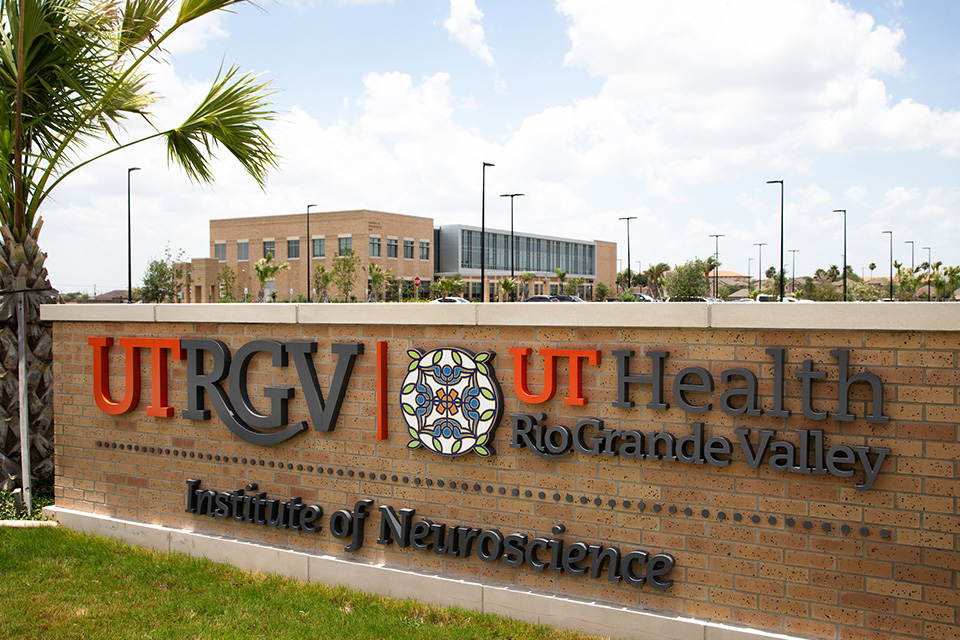
The UTRGV Rio Grande Valley Alzheimer’s Disease Resource Center for Minority Aging Research is located in the UTRGV Institute of Neuroscience in Harlingen. (UTRGV Photo by David Pike)
Maestre, who has led research on memory decline in the Valley for more than a decade, said the new statewide funding could further strengthen the work being done at UTRGV and similar institutions.
“Our team is building an infrastructure that not only studies why dementia is so prevalent in Hispanic communities, but also how we can prevent it,” Maestre said. “We hope that UTRGV will be among the institutions considered for future DPRIT support, so we can continue expanding our work in prevention, education and care for families most affected.”
A VISIONARY INVESTMENT
According to the Texas Department of State Health Services, more than 459,000 Texans are living with Alzheimer’s disease — 12% of the state’s population over age 65. In the Rio Grande Valley, the rate of dementia is nearly twice the state average, driven by genetic, environmental, and lifestyle factors.
Dr. Everardo Cobos, interim dean of the UTRGV School of Medicine and chair of the Department of Medicine and Oncology, praised the creation of DPRIT as “a visionary investment in both science and humanity.”
“Texas has shown extraordinary leadership in making this commitment to brain health,” Cobos said. “Just as the state transformed cancer research through the Cancer Prevention and Research Institute of Texas, DPRIT has the potential to transform dementia care and accelerate discovery. We are proud that UTRGV researchers are part of that growing movement.”
UTRGV President Guy Bailey also said the initiative represents a historic opportunity for Texas to lead in one of the most urgent health priorities of the century. “Proposition 14 sends a powerful message about who we are as Texans — innovative, compassionate and forward-thinking,” Bailey said. “We are deeply grateful to the voters for believing in science and for helping build a stronger, healthier future for all Texans.”
As DPRIT begins its work, university and community partners across the state are preparing to collaborate in new ways to address the growing burden of dementia through science, compassion and shared resolve.
“Every Texan who voted ‘yes’ helped bring us one step closer to a future without dementia,” Maestre said. “And that’s a legacy of hope that will endure for generations.”
To learn more about the UTRGV Rio Grande Valley Alzheimer’s Disease Resource Center for Minority Aging Research, visit www.utrgv.edu/som/alzheimers-disease-resource-center/en-us/index.htm.

